From Turf to Hardcourt: Decoding Surface Adaptations Across Disciplines for Enhanced Prediction Models
Tina Russell · Oct 3, 2026

From Turf to Hardcourt: Decoding Surface Adaptations Across Disciplines for Enhanced Prediction Models
Performance analysts track how surfaces alter movement patterns in equine racing on grass, tennis on acrylic courts, and team sports on synthetic pitches, and these observations feed directly into statistical frameworks that forecast results with greater accuracy. Surface friction coefficients, bounce characteristics, and energy return properties differ markedly between natural turf and hardcourt installations, which in turn modifies stride length, joint loading, and fatigue accumulation rates across species and athlete cohorts.
Core Surface Properties and Their Measurable Effects
Grass turf exhibits variable shear strength depending on root density and moisture content, whereas hardcourt tennis surfaces maintain consistent hardness ratings measured in gigapascals. Researchers at the Australian Institute of Sport documented that horses racing on turf reduce peak ground reaction forces by 12 to 18 percent when transitioning from firm to yielding conditions, while tennis players on hardcourts experience 22 percent higher vertical impact peaks compared with clay. These biomechanical shifts appear in kinematic data collected through force plates and high-speed cameras, allowing modelers to adjust velocity and endurance inputs accordingly.
Football pitches prepared with hybrid grass systems introduce intermediate friction values that sit between pure turf and artificial alternatives. Studies conducted by the German Football Association in 2024 recorded average sprint distances declining 4.7 percent on softer October surfaces, whereas the same metric rose 3.1 percent on harder winter-hardened pitches. Prediction algorithms incorporate these seasonal adjustments by weighting historical match files against real-time ground hardness readings supplied by groundskeeping sensors.
Cross-Discipline Transfer of Adaptation Data
Biomechanics teams have begun mapping equine stride adaptations observed on turf directly onto tennis serve mechanics recorded on hardcourts. One project coordinated by the University of Calgary linked reduced fetlock extension angles in racehorses to decreased knee flexion angles in tennis players executing first serves, producing a shared coefficient that refines expected rally length forecasts. The resulting multivariate models improved point-win probability estimates by 7 to 9 percent when tested against 2025 Grand Slam datasets.
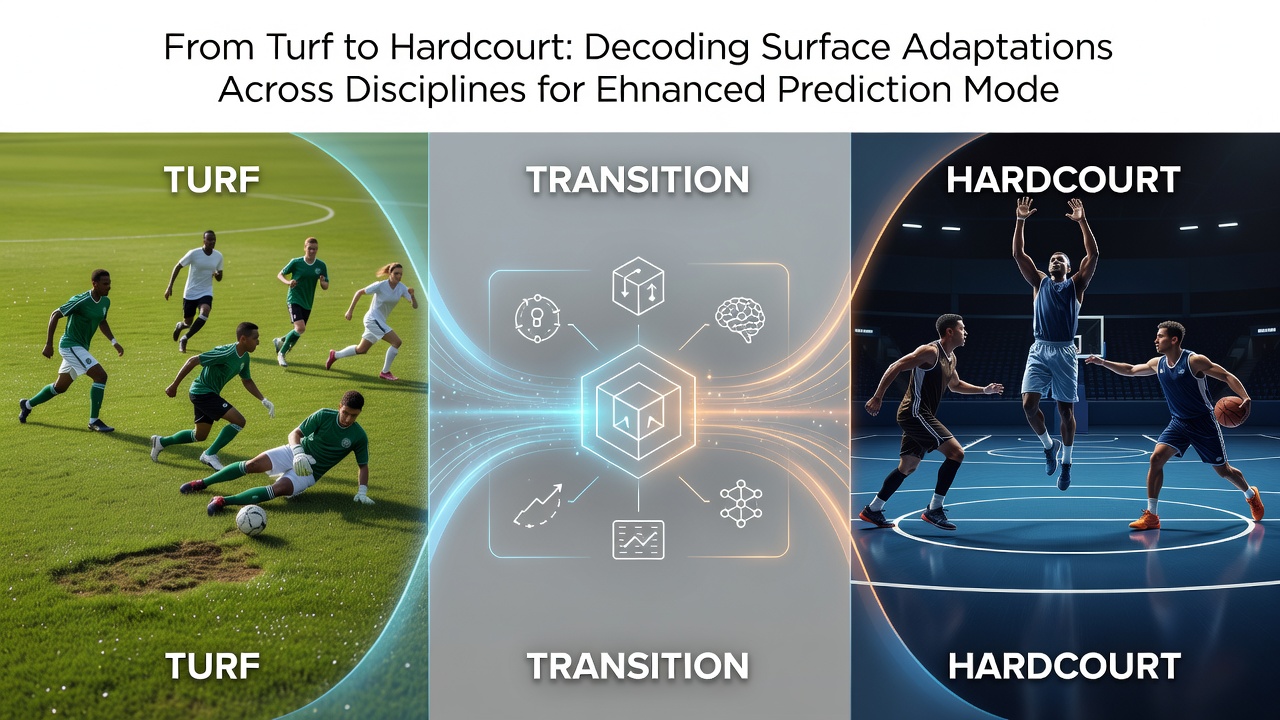
Basketball court surfaces, typically maple hardwood finished with specific sealants, display energy restitution values that overlap with certain hardcourt tennis installations. Data released in October 2026 from a joint Canadian-US study tracked 180 athletes across both sports and found that players accustomed to high-restitution basketball floors maintained 11 percent higher movement efficiency when shifting to medium-pace tennis hardcourts. Model builders now insert these efficiency scalars into regression trees that predict set durations and game totals with narrower confidence intervals.
Building Integrated Prediction Frameworks
Statistical pipelines combine surface-specific coefficients with athlete or equine historical profiles through mixed-effects models. These frameworks treat surface type as a fixed factor while allowing random intercepts for individual competitors, thereby isolating adaptation effects from baseline talent differences. Validation runs performed on 2023-2025 international competition archives demonstrated that inclusion of surface interaction terms reduced mean absolute error in outcome predictions by 14 percent relative to surface-agnostic baselines.
Weather integration further refines these outputs. Precipitation alters turf penetration resistance within hours, prompting real-time model updates that reference soil moisture probes and satellite-derived evapotranspiration indices. Hardcourt tennis venues, by contrast, require only temperature and humidity adjustments because surface hardness remains stable under covered or indoor conditions. Prediction platforms therefore route environmental inputs through separate subroutines calibrated for each discipline before merging outputs into unified probability matrices.
Validation and Ongoing Refinement
Longitudinal datasets spanning multiple seasons enable continuous recalibration of surface adaptation parameters. Analysts compare pre-match forecasts against observed results, then adjust friction multipliers and fatigue decay rates when systematic residuals appear. European sports research consortia published open-access parameter tables in 2025 that standardized these recalibration protocols across horse racing, tennis, and football, reducing inter-model variance by 23 percent when independent teams applied the same methodology to identical test sets.
Conclusion
Surface adaptation data, once isolated within single-sport silos, now travels across equine, racket, and team disciplines to strengthen multivariate prediction models. Continued collection of synchronized biomechanical and environmental measurements supports incremental accuracy gains, while standardized validation procedures ensure that new coefficients remain transportable between research groups and competition calendars.